
Mesa City Directory Holdings
The verified Mesa city directory shelf is small but unusually rich. The best documented item is a regional 1952 volume built from a house-to-house canvass and checks against employer information. It contains five ways into the same community: classified businesses, a numerical phone list, a street-ordered householder guide, an alphabetical resident section, and rural routes. A 1951 Mountain States telephone book and a Phoenix metropolitan directory add other entry points. The Phoenix title is not a reason to skip that volume because its Mesa alphabetical pages begin at page 559 and its Mesa rural routes at page 593.
| Collection | Verified date | Where kept | How to use it |
|---|---|---|---|
| Mullin-Kille and Baldwin regional directory | 1952 | Arizona Memory | Free digitized volume with name, street, phone, business, and rural-route divisions |
| Mountain States telephone directory | 1951 | Arizona Memory | Digitized phone book covering Mesa within the Phoenix service area |
| Phoenix metropolitan area directory | Verified Mesa pages | Arizona Memory | Mesa alphabetical and rural-route sections inside a metro-titled book |
| Mesa Room local history material | Dates vary by item | Mesa Public Library | Appointment access to noncirculating books, maps, newspapers, photos, scrapbooks, and microfiche |
| Museum catalog and archives | Dates vary by collection | Mesa Historical Museum | Catalog search, then written request and supervised research |
No official source found a complete year-by-year run, a first printed year, or a last printed year for Mesa city directories. That gap matters. A missing result may mean a volume was not published, was not preserved, is not yet cataloged, or simply remains offline. State those limits rather than filling a year range from an unrelated city.
Inside Mesa’s Five-Part Directory
The 1952 directory works more like a linked database than one long name list. Begin in the Resident and Cosmopolitan Telephone Directory when a surname is known. Move to the Householders’ Directory and Street Telephone Guide when an address is known. The phone division can resolve a partial number, while the business and rural-route divisions help with shops, farms, and households outside the ordinary street grid. This five-way check is useful because no single division captures every printed clue.
The publisher reported house-to-house canvassing checked against employer data. That method gives the entries weight as dated observations, but it does not turn them into government records. A refused interview, recent move, rural route, spelling error, or late change could keep a person out. Compare the resident entry with the street listing and phone division before treating a name-and-address pair as settled.
Printed population figures also reveal the book’s regional scale: Mesa 20,119, Tempe 8,375, Chandler 5,913, and Gilbert 1,241. They describe the directory’s own period and should not be read as current counts.
Read a Mesa Directory Entry
A sample 1952 line reads “Evans Walter W (Martha D) distr Standard Oil h 435 E 4th Av” followed by a telephone number. That compact line names the resident, spouse, occupation or role, employer, household status, address, and available phone. The exact code key controls the meaning. Do not assume a mark from a later book works the same way in this volume.
| Resident name | Surname, given name, and often a middle initial support name-variant searches. |
|---|---|
| Spouse or family | A spouse may appear in parentheses; dependents under 18 can appear in the resident division. |
| Occupation | A shortened position or employer can distinguish people with the same name. |
| Address | The house number and street connect the alphabetical and street-order divisions. |
| Status marks | The 1952 entries use markers such as h and r; confirm each against that edition’s key. |
| Telephone | An available number provides a second path through the numerical telephone section. |
- Criss-cross directory
- A directory arranged by street and house number rather than only by surname. It turns an address into a list of named householders.
- Householder index
- The street-order portion that lets a researcher move from a place to a printed householder.
- Abbreviation key
- The publisher’s legend for short forms and status marks. Save it before interpreting any entry.
Note: A directory entry is a publisher’s dated snapshot, so absence does not prove that a person was absent from Mesa.
Mesa City Directory Appointments
The Mesa Room sits in the Main Library basement at 64 E. First St. Its local-history, property, and genealogy material does not circulate. Appointments are offered Tuesday through Thursday from 10 a.m. to noon and 1 to 5 p.m. Each booking lasts one hour, with no more than two in a day. Reserve at least one week ahead through myLIBRO or call 480-644-3100.
Good preparation saves most of that hour. Put the sought names, known properties, date window, and catalog call numbers in the appointment note. Staff can then pull closed-stack items before the visit. Microfiche work must fit inside the booking, so ask whether the expected directory, newspaper, or property file is on fiche. Bring a research log and capture the volume title, publication date, page, section, and abbreviation key with every entry.
The room also holds books, maps, photographs, newspapers, scrapbooks, and other local material. These sources can explain why a household moved, why a street label changed, or why a surname appears in a local institution. They do not replace the directory; they supply the context around it.
Mesa Museum Name Searches
The Mesa Historical Museum catalog searches keyword, collection, name, date, and place. Only part of the museum’s collection is online, and the museum warns that catalog metadata can contain spelling or photograph errors. Try initials, married names, short street forms, and a broad date span. A weak online result is a reason to ask staff, not proof that no related material exists.
Research begins with a written request through the museum research service. Approved work is supervised at 2345 N. Horne, Tuesday through Saturday from 10 a.m. to 4 p.m.; the main number is 480-835-2286. Personal-use photographs cost $10. Cite the relevant city directory line in the request because its address, employer, and spouse can help staff locate an image, oral history, neighborhood file, or other named item.
The successful manifest image comes from the Mesa Historical Museum research page.
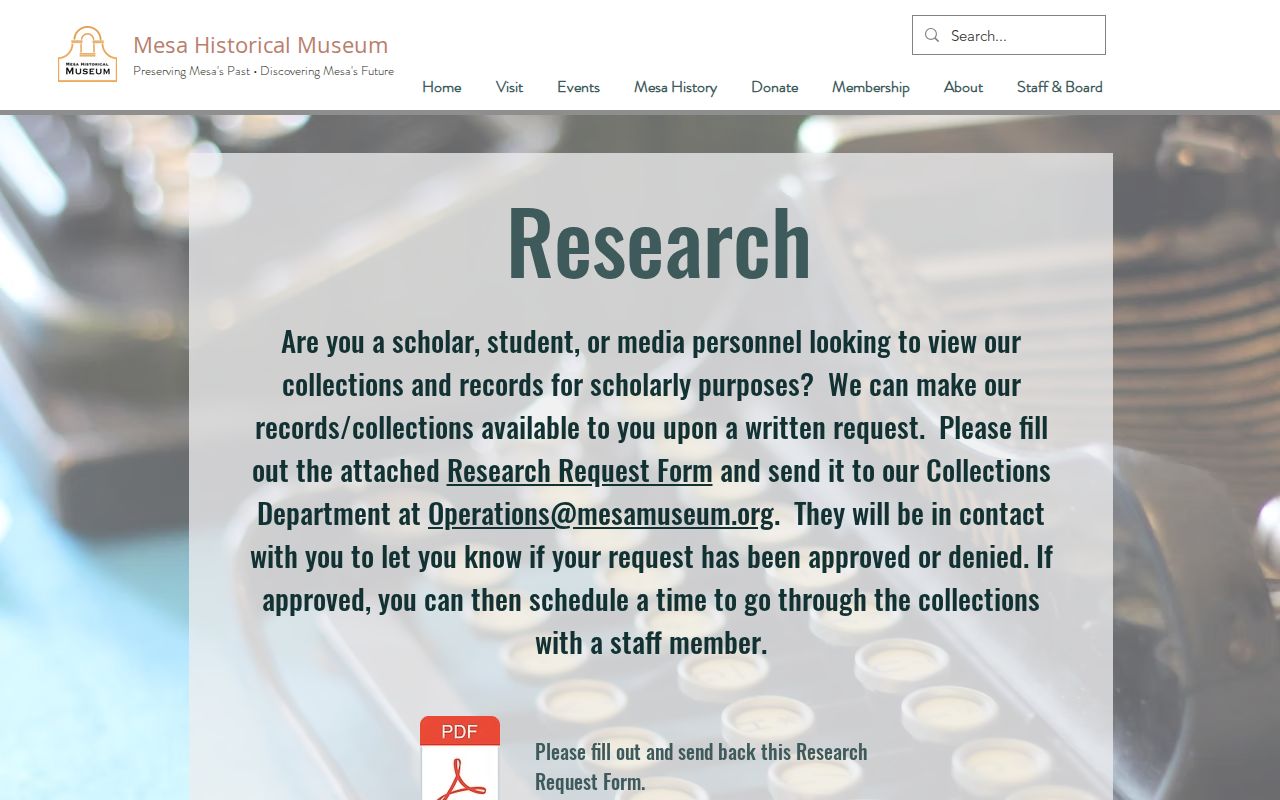
The captured page illustrates the staff-mediated route that complements the online catalog and printed Mesa city directory evidence.
Mesa Directory Digitization Story
A 2010 LSTA report documents a major Mesa Room transition. Staff digitized 1,286 closed-stack documents and converted 13 Washington Park oral histories from cassette to WAV and MP3. The project does not establish a complete city directory run, but it explains why useful local items may now have digital surrogates even when the physical originals remain controlled.
The wider records story stretches much farther back. Maricopa County’s Recorder dates to February 14, 1871. A county account says current records were microfilmed in the 1960s while older records back to county organization were being filmed. That account mentions dynamite found among courthouse holdings during sorting. It is a striking records-management story, not evidence of a fire or lost Mesa directory volumes.
Telephone service reached Mesa in 1902, and direct dialing followed after 1949. Those shifts help explain why a 1950s city directory can offer both a household address and a telephone route. Mesa’s growth from its 1878 settlement and 1883 incorporation also changed the scale and shape of each later directory.
Trace Mesa Families by Directory
City directories are strongest when treated as checkpoints between census years. The federal census identifies people at a household on its reference date, and public schedules currently run through 1950 under the 72-year release rule. A 1952 directory can then test whether a person remained nearby, changed address, or appears with a spouse and employer soon after that census. Neither source fills every day between those dates.
- Search the alphabetical resident division under the surname, initials, married name, and likely spelling variants.
- Copy the full line, then find the same house number in the street-order section to check the printed householder and nearby entries.
- Search the phone division and business section for a second match, especially when an employer or shop appears in the resident line.
- Compare the household with the 1950 census, then use deeds or probate only for the distinct questions those official records answer.
- If the person vanishes, test a move, death, changed surname, rural route, unlisted phone, and publication gap before drawing a conclusion.
A deed proves a recorded transfer, not who slept at the address that night. A census names an enumerated household on one date. A directory reflects the publisher’s canvass. Agreement among them is far more useful than stretching any one record beyond what it states. For present-day name checks, shift to the Mesa resident lookup rather than treating an old book as a current roster.
Close Mesa Directory Trails
When a person disappears from the Mesa city directories, the library’s obituary search service can test one possible endpoint. It searches Arizona Republic obituaries from May 28, 1890 through December 31, 2009. The request is mail-based and costs $15 per nonrefundable search. Send the form and a check or money order to Mesa Public Library, Obituary Search Requests, P.O. Box 1466, Mesa, AZ 85211. The newspaper site covers 2002 forward.
An obituary is a biographical clue, not a death certificate. It can connect relatives, a later place, and community ties, while probate or an eligible vital-record request may supply official evidence. Cemetery results should also be confirmed with cemetery staff. Mesa Community College’s noncirculating archives add a different path for former classmates: the Jacali yearbook ran from 1965 through 1979, and alumni newsletters cover 2019 through 2026.
The careful finish preserves uncertainty. Verified Mesa city directory dates should stay verified, and missing years should stay missing until a library, archive, or catalog supplies the evidence.