
Mesa Previous-Resident Evidence by Era
A backward address trail begins with the newest dependable identifier, then steps into sources suited to each era. The assessor provides today’s parcel number, or APN, legal description, subdivision reference, owner, mailing address, situs address, and deed link. Situs means the physical property location; the tax mailing address may be elsewhere. The deed chain names parties to recorded transfers. Directories and census schedules are better tools for past residents because they can place people at the address even when they did not own it.
| Source | Time span it covers | Custodian or collection | Evidence returned |
|---|---|---|---|
| Assessor parcel record | Current roll plus displayed sale and value history | Maricopa County Assessor | APN, current owner, mailing and situs addresses, deed, subdivision, and legal description |
| Recorded document index | No single earliest online year stated; full text is limited to the latest two years | Maricopa County Recorder | Grantors, grantees, dates, document type, legal description, and images |
| Householders’ street guide | Verified 1952 volume | Arizona Memory | Street-order householders, ownership marks, and available phones |
| Federal census | Public schedules through 1950 | Federal census collections | Household members on the census reference date |
| Mesa permits | Direct public search from 2017; formal retrieval for earlier files | Mesa DIMES | Dated construction, alteration, planning, and code activity |
| Obituary search | May 28, 1890 through December 31, 2009 | Mesa Public Library | Reported death, relatives, and later biographical clues |
Choose by question. Use deeds for recorded ownership, the directory or census for households, and permits for activity at the site. No source proves all three. Sanborn fire-insurance maps can supply footprint, material, and street context, but the research did not verify a complete Mesa-specific sheet-and-year list. Confirm the relevant map in the Library of Congress Sanborn collection before claiming coverage.
Mesa Previous-Resident Deed Bridge
The most useful local shortcut is the deed number on the Maricopa County Assessor parcel page. An exact Mesa address can lead to the APN and present deed without guessing how the Recorder indexed the street. Save the APN, legal description, subdivision or MCR reference, both current addresses, and deed number before opening the recorded instrument. Those fields become continuity checks when the street string changes.
The assessor’s name is an owner clue, not an occupant roster. A trust may own the parcel. Mail may go to another address. The roll can also lag a recent recording. These facts do not show who lived there. They establish the modern parcel from which the search for previous residents can move backward.
Key distinction. A recorded owner, tax-mail recipient, and person living at a Mesa address can be three different people.
Walk Mesa Past-Resident Deeds Backward
Open the current deed in the Maricopa County Recorded Document Search. Record the buyer, seller, execution date, recording date, return address, and exact legal description. The buyer is the grantee; the seller is the grantor. Next, search that seller as an earlier grantee. A matching legal description connects the transfer far more safely than a similar street address or surname.
- Resolve the modern Mesa address to its APN, subdivision, legal description, and current deed number.
- Read the current deed and copy the grantee, grantor, dates, and legal description.
- Search the grantor as a grantee in an earlier date range, using separate searches for initials, married names, and spelling variants.
- Compare the legal description, not just the street label, then repeat with the next seller.
- When the web index becomes uncertain, use docket or book-and-page references, request parcel history, inspect records, or ask about archival microfilm.
- Grantor and grantee
- The grantor transfers the recorded interest; the grantee receives it.
- Chain of title
- The linked sequence of recorded transfers for the same legal parcel.
- Legal description
- The land’s formal lot, block, subdivision, or survey identity, which is more stable than a postal address.
- Corrective instrument
- A later recording that fixes or clarifies an earlier document and must remain with the chain.
A deed establishes a conveyance, not the day a household moved. Compare execution and recording dates, watch for later corrections, and treat a return address as a document clue rather than an occupancy statement.
Mesa Previous-Resident Search Limits
The Recorder’s Research full-text mode covers only the latest two years, even though the structured person, business, document-number, and docket or book-and-page modes reach farther. The current official interface does not publish one authoritative earliest online date. That is why an old-address keyword search can fail while a party-name or legacy reference still works.
For people, the Recorder recommends last and first name. Trusts, HOAs, and subdivisions belong in Business Name mode. Date limits and document codes can reduce noise. An unofficial document image opens from the colored Pages control. Official copies cost $1 per page, with $3 added per certified document. Free appointment inspection is available at 301 W. Jefferson St., Suite 200, Phoenix, Monday through Friday from 8 a.m. to 5 p.m.; the phone is 602-506-3535.
Other channels remain important. The Recorder accepts mail orders with a self-addressed stamped envelope. Official or certified copies can be ordered for email delivery or mail. Administrative records may be requested under Arizona Public Records Law through the county request channels by portal, email, or fax. Staff record documents but do not perform a title search or promise that a parcel is free of liens.
Note: Mesa is not the county seat, so core deed records and in-person Recorder inspection are centered in Phoenix.
Find Mesa Past Residents at Home
Ownership supplies the frame; household sources add people. The verified 1952 Mesa, Tempe, Chandler, and Gilbert directory has an alphabetical resident section and a Householders’ Directory and Street Telephone Guide. Use the name side to find an address, then the street side to see the printed householder and nearby entries. The separate Mesa city directory collections page explains that volume and its codes in full.
Pair the directory with the 1950 census. The census identifies people enumerated at a household on its reference date, while the directory reflects a later publisher canvass. Agreement can support continuity. A difference may reflect a move, publication gap, changed name, refusal, or a rural-route entry. It does not justify inventing who occupied the address in the years between.
- Find the address in the 1952 street section and copy the householder, phone, and any ownership mark.
- Find that surname in the alphabetical section to capture spouse, dependents, position, employer, and full address clues.
- Locate the household in the 1950 census using name, place, and family details rather than assuming the modern ZIP existed.
- Compare deeds for ownership and note any renter or household member absent from the property roll.
- Continue with the next verified directory, census, obituary, or probate source and label every uncovered year as a gap.
A criss-cross directory is arranged by street and house number. It can show a printed householder who never appears as owner. An enumeration district is the geographic area assigned to a census taker and may help when name indexing fails.
Keep Mesa Past-Resident Addresses Connected
Street text is less durable than land identity. Preserve the APN, legal description, subdivision or MCR, map location, and current deed before going backward. If an old address stops producing results, search the legal description and plat. Also test changes in direction, street type, unit number, parcel splits, parcel combinations, annexation, and subdivision name. A postal ZIP is a late attribute and should not be forced onto an early Mesa record.
Historic district dates help set expectations. Evergreen has a cohesive 1910 to 1948 period. Gold Spot Groves dates to 1931, McLellan Acres to 1946, North Lehi Acres or Lehi Subdivision to 1947, Mesa Cemetery to 1923, Granite Reef Estates to 1954 and 1955, and Biggs Addition to 1953 and 1955. Robson reflects denser reuse of large original Mormon garden lots. Vista Gardens is postwar. These anchors suggest when a plat, directory, deed, or permit is likely to begin, but they do not name previous residents by themselves.
Mesa grew far beyond its original one-square-mile townsite. Annexation and new subdivisions can shift the relevant government and source set. Verify that an old place was within Mesa at the date being researched before asking the city for a file.
Mesa Previous-Resident Property Clues
Mesa DIMES adds a dated property chronology. Records from 2017 forward can be searched without an account by quoted address, record number, or name. Open the blue record-number link. Earlier documents and zoning-verification letters require a logged-in Document Retrieval request, with one address or property per request. Permits, planning files, and code cases record activity, but an applicant, contractor, or named owner is not always an occupant.
Mesa Fire adds an unusual second line of evidence. Its commercial-property request is stored by full street address, not APN, and returns the previous three years of inspection and hazardous-material history. Only one address is allowed per request, and the portal is required. That address/APN mismatch makes it wise to retain both identifiers throughout the search.
The successful page image was captured from the official Mesa Fire records and reports channel.
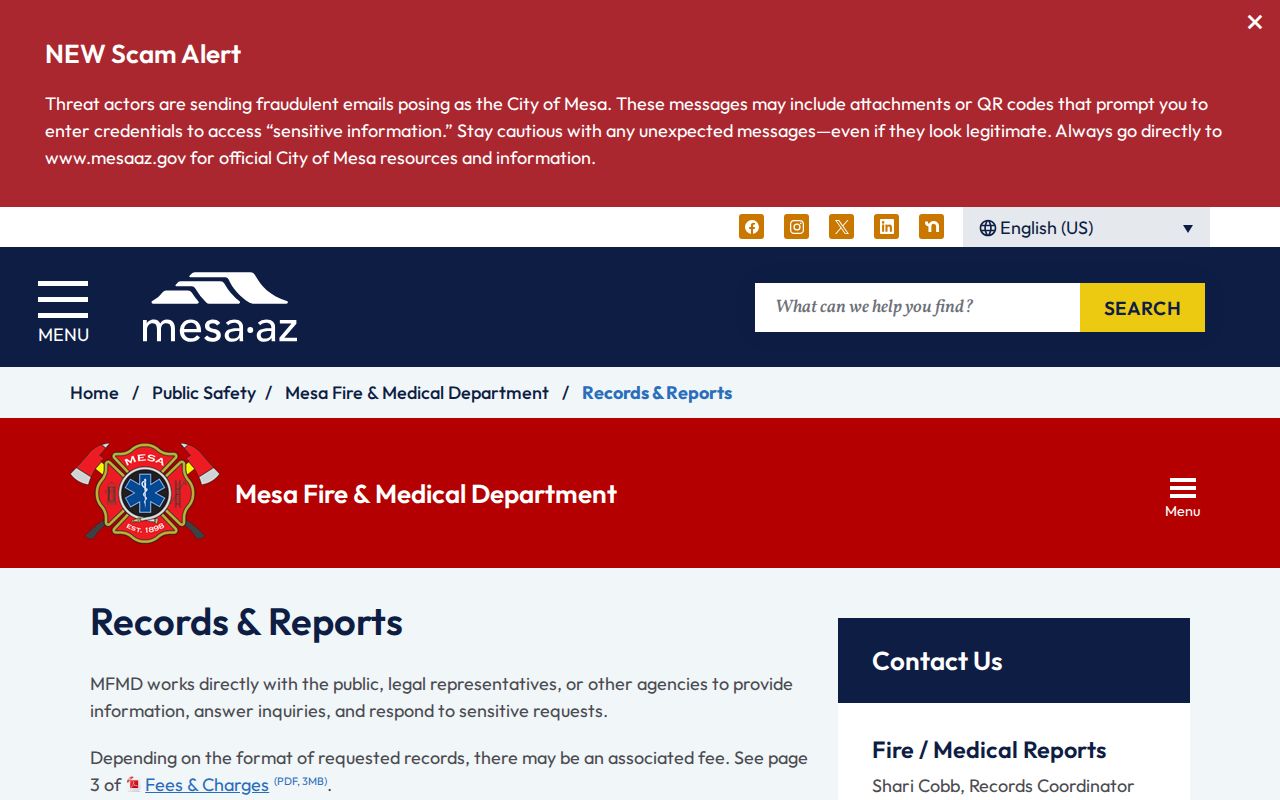
The captured request route shows how a full street address, rather than a parcel number, opens this recent inspection timeline.
Close Mesa Previous-Resident Trails
Probate and obituaries can connect a deceased owner to a personal representative, heirs, relatives, and a later place. The public probate petition is stronger evidence of the legal estate relationship than an unsourced obituary claim. Probate records belong to the Clerk of the Superior Court in Maricopa County, not the County Recorder.
Mesa Public Library’s obituary service searches Arizona Republic obituaries from May 28, 1890 through December 31, 2009. Mail the form with a check or money order to Mesa Public Library, Obituary Search Requests, P.O. Box 1466, Mesa, AZ 85211. The fee is $15 and is nonrefundable for each search. Newspaper web coverage begins in 2002. An obituary is still a clue, not a death certificate.
Older or difficult records may require Arizona State Archives catalog help, Mesa Room material, museum staff, Recorder inspection, or microfilm. This fallback chain is part of sound research, especially because no complete directory run or Mesa Sanborn-year list was verified.
Lawful use. Research Mesa previous residents for house history, genealogy, estates, and personal curiosity. Never use an address trail to track, harass, or harm a living person.